

The 5 Best Compasses

The irony of that awesome compass app on your iPhone is that cellular devices rarely have coverage when you’re lost in the mountains. This is where the skilled but nearly forgotten analogue-art of the compass comes into play. Whether you’re a professional surveyor or an amateur backpacker, a professional-grade compass is a handy, if not necessary, tool. After diligent research, we've chosen five of our favorite compasses currently available on the market. If this is your first time shopping for a compass, we also suggest you “get directions” from a good eBook or external resource covering the basics of compass use before you head out on your adventure (see what we did there?).
Suunto MC-2G

Playtime is Over
In business since 1936, Suunto has become a household name among adventure enthusiasts for its line of compasses, dive products, sports watches and more. With the typical price of an professional compass being around $50, we’ve determined that the Suunto MC-2G Global is the best overall for most folks out there searching for a new compass. It occupies a sweet spot between being feature-rich, affordable, and dependable. With its globally-balanced needle, the MC-2G is especially useful for mountaineers who plan on traveling to both the northern and southern hemispheres.
Pros:
- 20-degree tilt margin for easier readings
- Adjustable declination correction
- Liquid-filled capsule for stable operation
- Jewel-bearing needle
Cons:
- Lid doesn’t shut easily
- Plastic lanyard attachment is janky
Coghlan’s Map Compass
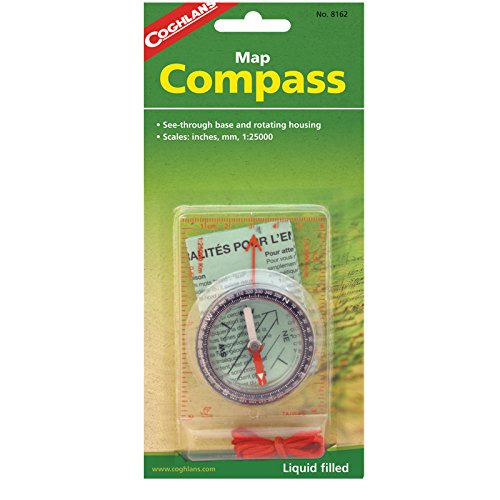
Stop Being Lost For The Price Of A Latte
At less than five bucks, this the Coghlan compass that was designed for everyday – and everyone. One feature we especially like is that it’s long enough to reach between most map points when plotting. While it’s most useful for map reading, its other features are worth noting too, like its see-through liquid-filled base, or its jeweled needle with a luminous pointer for nighttime adventures. In addition, the price is so reasonable, you could buy a couple of these and slip them into all your camping gear, so a compass is always close at hand.
Pros:
- Magnifier lens for more detailed map-reading
- Incredibly accurate for the price
Cons:
- Needle isn’t liquid-dampened
- Bezel rotates too easily
- No magnetic declination setting
Peco Silva Ranger 2.0

The Swedish Know Their Way
Another outdoors equipment company with nearly 90 years of experience, Silva was founded by the three brothers who invented first the liquid-filled compass, the first marine compass and the first mirror-sighting compass. The Ranger 2.0 is the latest incarnation of Silva’s advanced, mirror-sighting compasses created for experienced users and professionals. It’s important to note that the Clinometer reads to 90-degrees in all four quadrants, which is great for surveyors, but will require a little extra math for other forms of map-reading.
Pros:
- Distance lanyard with 1:25 and 1:50 scales
- Rotating compass dial has gradations every 2A degrees
- Built-in magnetic declination adjustment screw
Cons:
- Design makes azimuth angles difficult
- Global needle comes with a different model
Cammenga S.W.A.T.Black Titrium

S.W.A.T. Do You Mean We’re Lost?
For serious hikers, surveyors and cartographers ready to throw down a cool Ben Franklin for their gear, the Cammenga Tritium Lensatic can handle whatever nature dishes out. Features include a climate capacity of 50 degrees below zero to 150 degrees Fahrenheit and seven Tritium micro lights for navigation in low-light conditions. The micro lights remain luminous for over twelve years, never requiring maintenance. The compass even includes a patented Copper Induction Damping System, which slows the rotation of the magnet without the use of liquids. Combine that with a solid aluminum casing, and you’ve got a compass that can only be described as bad ass.
Pros:
- Can withstand rigorous shock
- Durable aluminum frame and waterproof housing
- Magnifying lens and sight wire included
Cons:
- Glow is faint
- Complex features not suitable for beginners
Brunton USA 1894 Gentleman’s Compass

Can A Compass Be Any Cooler?
Ok, we can’t exactly say we cheated on this one, but we may have chosen this compass for its Cool Factor over things like, say, practicality. Modeled after an original design by it’s namesake: D.W. Brunton, dating back to 1894, the USA 1894 Gentleman’s Compass features the classic cardinal direction points and a lift arm that helps extend the compass’s life by stopping unnecessary needle movement. A lightweight aluminum housing protects this well-crafted unit, assuring years of reliable service.
Pros:
- Made in the USA
- Makes for a great gift
Cons:
- Casing face is plastic, not glass
- No declination
Frequently Asked Questions
Will my compass be adjusted when I receive it?
For the most part, yes. Although many factors can create deviation, most of these involve magnets being too close to the compass. We recommend that, upon the package’s arrival, you perform a compass adjusting procedure by using a known directional reference (i.e. a sun azimuth or a known land bearing).
When should I consider purchasing a new compass?
Although broken compasses can be repaired, the smaller, mobile, portable varieties typically should be replaced when the following occurs:
1. When there are noticeable cracks in the dome.
2. When fluid levels are low (for example, when you see a bubble) or the fluid is empty from the casing.
3. The dial or card is discolored or yellow.
Is a cheap compass dependable?
Generally speaking, even a “cheap” compass is going to give you an accurate indication of direction (as opposed to an accurate bearing). It really depends on how you want to use the compass. If you’re looking for a general idea of where magnetic north is, even the cheapest compass is helpful. More expensive models get you faster needle orientation, better damping, better handling of magnetic variation, and features that allow you to work in both the northern and southern hemispheres.